
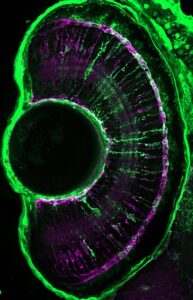
unit=micron
Our group’s main interest is to understand regenerative processes to address health challenges with high impact on quality of life.
We focus on the roles of cellular metabolism and the tissue microenvironment in regeneration and cancer. We apply systems-biology approaches and experimental methods, including advanced genetics, high-resolution microscopy, and multi-omics analytics, to study retina and fin regeneration in zebrafish, and cancer biology using human organoids. We expect that work across animal models and human in vitro systems will deepen understanding of tissue physiology and disease. Ultimately, we aim to enable better diagnostics and novel therapeutic strategies by enhancing human regenerative capacity.

PROJECTS
Project description
Vision impairment is a major health challenge worldwide, and our project seeks to uncover the molecular and metabolic mechanisms that could unlock the regenerative capacity of the human retina. While zebrafish can naturally regenerate their retinas through Müller glia reprogramming, mammals lack this ability, leaving diseases such as glaucoma, macular degeneration, and diabetic retinopathy without regenerative treatments. Building on our findings that metabolic reprogramming drives tissue repair, we will investigate how protein lactylation and O-GlcNAcylation regulate Müller glia dedifferentiation during zebrafish retina regeneration, and test whether similar mechanisms can be activated in human retinal organoids.
By combining these complementary systems, the project aims to reveal conserved metabolic adaptations across species and pave the way for new therapeutic strategies to restore vision and counteract retinal diseases.
Principal Investigator: António Jacinto
Start date: 1 October 2025
End date: 31 March 2028
Funded under: Fundação para a Ciência e a Tecnologia
Funding scheme: FEDER / Programa Regional de Lisboa 2030
Grant agreement ID: 15085
DOI: https://doi.org/10.54499/2023.16233.ICDT

Project description
MERIT-H aims to elucidate the metabolic–epigenetic mechanisms by which lactate sustains the activation of cancer-associated fibroblasts in hepatocellular carcinoma (HCC), and to determine whether targeting these pathways can enhance therapeutic response. By dissecting the interplay between tumour metabolism and stromal cell reprogramming, the project seeks to uncover novel vulnerabilities within the tumour microenvironment that may be exploited therapeutically.
Integrating mechanistic studies with clinically annotated patient samples in close collaboration with Curry Cabral Hospital, MERIT-H bridges fundamental research and clinical application. This translational approach strengthens the project’s potential to inform the development of more effective treatment strategies for HCC.
Principal Investigator: António Jacinto
Start date: 01/03/2026
End date: 28/02/2028
Duration: 24 M
Funded under: Liga Portuguesa Contra o Cancro – Núcleo Regional do Sul (LPCC-NRS) / Jerónimo Martins 2026
Grant agreement ID: ongoing
DOI: (link to the project): n/a


TEAM

Left to right: Daniel Ribeiro, Ana Patrícia Silva, Raquel Lourenço, António Jacinto, Rute Salvador, Rita Pereira, Maria Inês Pimenta, Maria José Silva, Inês Gomes, Ana Teresa Tavares
Group Leader
António Jacinto holds a degree in Biochemistry (1993) from the University of Lisbon and a PhD in Developmental Biology and Genetics (1999) from Imperial College London. He completed postdoctoral training at University College London and established his independent research group at the Gulbenkian Institute of Science (Oeiras) in 2002. In 2004, he joined the Institute of Molecular Medicine (Lisbon) as a group leader, where he led research projects and contributed to institutional activities. In 2011, he moved to NOVA Medical School as a Principal Investigator; he coordinated CEDOC – Chronic Diseases Research Centre (2011 – 2019) and served as Vice-Dean for Research (2014–2021). He is currently the Executive Director of the NOVA Institute for Systems Biomedicine, funded by Horizon Europe’s Teaming for Excellence programme. His research focuses on the role of cellular metabolism in tissue regeneration and cancer.


PhD, Senior Investigator
Raquel De Amaro Lourenço is a researcher dedicated to uncovering the cellular mechanisms that regulate tissue regeneration, with a particular focus on metabolic and epigenetic reprogramming for regenerative therapies. Her recent work using the zebrafish model has provided valuable insights into potential therapies for degenerative diseases, particularly in the contexts of retinal (Lourenço et al., 2021, Front Cell Dev Biol) and bone regeneration (Mateus et al., 2015, Development; Brandão et al., 2019, J Cell Sci; Brandão et al., 2022, eLife).
Currently, her research explores how metabolic reprogramming through lactate production influences tissue regeneration. Raquel has demonstrated strong leadership in project management, experimental design, and grant and manuscript writing. She has supervised undergraduate and Master’s students, mentored PhD candidates, and actively participated in academic juries.
PhD, Senior Investigator
Ana Teresa Tavares graduated in Biology from Faculdade de Ciências (UL, Lisbon) in 1993, and joined the Gulbenkian PhD Programme in Biology and Medicine in 1995. Ana developed her PhD studies at the Salk Institute for Biological Studies (La Jolla, USA) and presented her thesis on Limb Development at Faculdade de Medicina (UL, Lisbon) in 2001. Ana’s postdoctoral studies were conducted at Instituto Gulbenkian de Ciência (Oeiras), and in 2007 she became an independent Research Fellow at the same institution. In 2009, Ana was granted a five-year Research Scientist position (FCT “Ciência 2007” programme) at the Vascular Development laboratory of Faculdade de Medicina Veterinária (UL, Lisbon). In 2015, Ana integrated the Tissue Repair and Inflammation group at NOVA Medical School (UNL, Lisbon) as a senior Postdoctoral Researcher. Since 2011, Ana is also an invited Lecturer and Chair of Developmental Biology at ISPA – Instituto Universitário (Lisbon).
Research Assistant
Daniel Ribeiro holds a PhD degree on Biomedical Sciences from the Faculty of Medicine, University of Lisbon. In that period, he made significant contributions to the field of Acute Lymphoblastic Leukemia. Daniel considers research is making major strides as it becomes progressively reliant on high-throughput technologies, as such he became increasingly interested in bioinformatics. Lately, he focused his research interests into bioinformatics, and while integrating his strong wet lab background in the analysis and interpretation of computational data, began exploring the themes of tissue healing, regeneration and cellular senescence in the context of Spinal Cord Injury. At NIMSB he is working on bioinformatic analysis of molecular and biomedical science data.
PhD, Researcher
Rute Salvador obtained a master’s degree in Oncobiology-Molecular Mechanisms of Cancer from AlgarveUniversity (2019). She also completed a Clinical Trials Coordination course in 2018, gaining valuable skills to interact with nurses and doctors in clinical settings. During her internship at Beatriz Ângelo Hospital, where she refined her ability to manage clinical trial logistics, she enhanced her communication and collaboration in clinical environments. She is proficient in various laboratory techniques, including flow cytometry, diverse cell culture methodologies (encompassing 3D co-cultures and primary cell cultures), microscopy and ELISA. Throughout her journey, Rute has gained experience in clinical research, specifically in managing patients’ databases, ethical committees’ approvals and writing informed consent forms. Rute has co-authored several posters and also 7 papers published in peer-reviewed international journals.
PhD, Researcher
Maria José Silva obtained her MSc in Pharmaceutical Sciences in 2016 from the Faculty of Pharmacy, University of Lisbon (FFUL). During her master’s degree, she joined Gois group to work on Chemical Biology and later, she did a 3-month internship at Sapienza, Università di Roma in Medicinal Chemistry thanks to the Erasmus Programme. In 2022, she received her PhD at FFUL in a joint project under the supervision of Dr. Pedro Gois and Prof. Dr. Gilles Gasser on novel site-selective bioconjugation strategies applied to targeted photodynamic therapy. Thereafter, she joined the group of Prof. Tanja Weil as a postdoctoral researcher and member of the mass spectrometry (MS) core facility at the Max Planck Institute for Polymer Research in Germany for 3 years. Since January 2026, she joined Jacinto lab as a Junior Researcher to work on MS-based omics aiming to uncover regulatory mechanisms of cancer immunity and resistance.
PhD, Fellow
Inês Gomes has a BSc in Biology with a specialization in Molecular Biology and Genetics and also a MSc in Molecular Biology and Genetics given by the Faculty of Sciences (University of Lisbon). She developed her master thesis at the Oncology Institute in Lisbon (IPOLFG), in Barret’s esophagus cancer progression. Currently, she is a PhD student in Health Sciences at NOVA Medical School in Lisbon, working in epigenetic alterations and it’s impact in cancer.
PhD Fellow
Ana Patrícia Silva started her academic life with a Bachelor’s in Biology and wandered into the Marine Biology field, wherein she worked in several laboratories. She followed these experiences by a Master’s in Bioinformatics after an opportunity allowed her a glimpse in this field and inspired her. She’s currently in a research fellowship at NIMSB and a PhD student, working in metabolic models.
PhD Fellow
Rita Pereira is a Molecular Biosciences PhD student at ITQB (NOVA University Lisbon). She completed her BSc in Biology in 2021 at Instituto Superior de Agronomia (University of Lisbon), and her MSc in Biomedical Research in 2025 at NOVA Medical School (NOVA University Lisbon). Her research training began in plant biology, leading to a first-author publication (Pereira et al., 2024, Front Plant Science), and later transitioned to human biology and disease-oriented research. Her project at NIMSB focuses on the metabolic reprogramming of cancer-associated fibroblasts (CAFs) to improve therapy response in hepatocellular carcinoma, using 3D cell model systems. Her research interests include tumour metabolism, epigenetic regulation, and the tumour microenvironment.
PhD Fellow
Maria Inês Pimenta is a PhD student focused on overcoming the metabolic barriers T-cells face within the immunosuppressive microenvironment of solid tumors. Her research integrates dynamic computational modeling with pharmacological intervention and genetic engineering of T-cells in vitro to identify and validate gene targets to improve T-cell fitness and activity.
She holds an MSc in Molecular Genetics and Biomedicine (FCT-NOVA) and a BSc in Biology (FCUL), with research experience from ITQB NOVA and University College Dublin. She is driven by a passion for translational medicine and the potential of systems biology to yield real-world solutions. Her goal is to transform predictive insights into experimentally validated interventions, developing innovative diagnostic and therapeutic tools. Ultimately, she aspires to conduct research that delivers a tangible impact, directly enhancing patient outcomes and quality of life.

SELECTED PUBLICATIONS
Porfírio-Rodrigues P; Pereira T; Jacinto A; Lara Carvalho. Dachsous is a key player in epithelial wound closure through modulating cell shape changes and tissue mechanics. Journal of cell science (2025) (doi:10.1242/jcs.263674)
Ana S Brandão; Jorge Borbinha; Telmo Pereira; Patrícia H Brito; Raquel Lourenço; Anabela Bensimon-Brito; Antonio Jacinto. A regeneration-triggered metabolic adaptation is necessary for cell identity transitions and cell cycle re-entry to support blastema formation and bone regeneration. eLife 11 (2022) (doi:10.7554/eLife.7698787)
Diana P Saraiva; Bruna F Correia; Rute Salvador; Nídia de Sousa; Antonio Jacinto; Sofia Braga; MG Cabral. Circulating low density neutrophils of breast cancer patients are associated with their worse prognosis due to the impairment of T cell responses. Oncotarget 12 24 (2021) (doi:10.18632/oncotarget.28135)
Diogo Paramos-de-Carvalho; Isaura Martins; Ana Margarida Cristóvão; Ana Filipa Dias; Dalila Neves-Silva; Telmo Pereira; Diana Chapela; et al. Targeting senescent cells improves functional recovery after spinal cord injury. Cell Reports 36 1 (2021) (doi:10.1016/j.celrep.2021.109334)
Lara Carvalho; Pedro Patricio; Susana Ponte; Carl-Philipp Heisenberg; Luis Almeida; André S. Nunes; Nuno A.M. Araújo; Antonio Jacinto. Occluding junctions as novel regulators of tissue mechanics during wound repair. The Journal of Cell Biology (2018) (doi:10.1083/jcb.201804048)