
Our group investigates the neuroimmune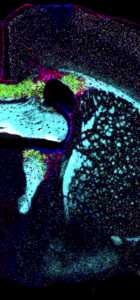 interface as a complex system, uncovering how cellular interactions and molecular mechanisms shape both normal function and disease.
With a focus on the neuroimmune axis as an integrated system, we seek to understand how diverse cellular populations and molecular programs integrate to support normal brain function and drive disease. We combine high-resolution spatial and multi-omic approaches to characterize how neurons, glia, and immune cells interact within tissue architecture, linking cell state, location, and function. This systems-level perspective allows us to move beyond individual components to uncover how coordinated cellular and molecular interactions give rise to emergent properties of tissue organization and activity.
A central focus of our work is to define how these interactions become disrupted across space and time in chronic neurological and neuroinflammatory conditions. We investigate how local cellular perturbations propagate through tissue environments, contributing to sustained inflammation, tissue remodeling, and degeneration.
Through the integration of experimental perturbations, in vivo modeling, and human tissue analysis, we aim to identify the fundamental principles governing neuroimmune system behavior and leverage these insights to inform more precise, context-aware therapeutic strategies.

PROJECTS
Project description
Multiple sclerosis (MS) evolves from an early inflammatory phase driven by peripheral immune cell infiltration to a progressive stage characterized by chronic, compartmentalized inflammation within the central nervous system. As the disease advances, lesion location, cellular composition, and underlying mechanisms shift, with increasing involvement of cortical and subpial regions and reduced blood–brain barrier disruption. Understanding the mechanisms that drive this transition to progressive disease is a central goal of this work.
This project focuses on two complementary mechanisms that may underlie disease progression. First, it examines how persistent, organized immune cell aggregates in the meninges contribute to local inflammation and drive neurodegeneration in adjacent brain tissue. Second, it investigates how inflammatory signals and damage may propagate along neuronal connections, linking white matter lesions to grey matter degeneration. Together, these aims seek to define how localized and distributed inflammatory processes interact to shape lesion development and progression, providing insight into the drivers of chronic MS pathology.
Principal Investigator Name: Leslie Rubio Rodríguez-Kirby
Start date: July 1st, 2024
End date: June 30th, 2029
Funded under: National Multiple Sclerosis Society
Grant agreement ID: TA-2305-41342

TEAM
Group Leader
Dr. Leslie Rubio Rodríguez-Kirby leads a research program focused on understanding how neuroimmune interactions shape brain development, function, and disease progression. She earned a Bachelors of Science in Biology from California State University, Fullerton and Ph.D. in Cell and Molecular Medicine from the Johns Hopkins University School of Medicine. For her postdoctoral training she joined the laboratory of Dr. Castelo-Branco at the Karolinska Institutet in Sweden.
Driven by a commitment to both fundamental discovery and translational impact, Dr. Rubio Rodríguez-Kirby seeks to bridge mechanistic insights across biological scales. Her research aims to elucidate the principles that link brain function and dysfunction, ultimately informing the development of more precise diagnostic tools and therapeutic interventions for complex neurological and psychiatric disorders.


SELECTED PUBLICATIONS
Zhang, D., Rubio Rodríguez-Kirby, L.A., Lin, Y. et al. Spatial dynamics of brain development and neuroinflammation. Nature (2025) (doi:10.1038/s41586-025-09663-y)
Zheng, C., Hervé, B., Meijer, M. et al. Distinct transcriptomic and epigenomic responses of mature oligodendrocytes during disease progression in a mouse model of multiple sclerosis. Nat Neurosci (2025) (doi:10.1038/s41593-025-02100-3)
Petra Kukanja, Christoffer M. Langseth, Leslie A. Rubio Rodríguez-Kirby, …, Markus M. Hilscher, Mats Nilsson, Gonc¸alo Castelo-Branco. Cellular architecture of evolving neuroinflammatory lesions and multiple sclerosis pathology. Cell (2024) (doi:10.1016/j.cell.2024.02.030)
Mandy Meijer, Eneritz Agirre, Mukund Kabbe, … Leslie Kirby…, Howard Y. Chang,Dheeraj Malhotra, Gonçalo Castelo-Branco. Epigenomic priming of immune genes implicates oligodendroglia in multiple sclerosis susceptibility. Neuron (2022) (doi:10.1016/j.neuron.2021.12.034)
Kirby, L., Jin, J., Cardona, J.G. et al. Oligodendrocyte precursor cells present antigen and are cytotoxic targets in inflammatory demyelination. Nat Commun. (2019) (doi:10.1038/s41467-019-11638-3)